
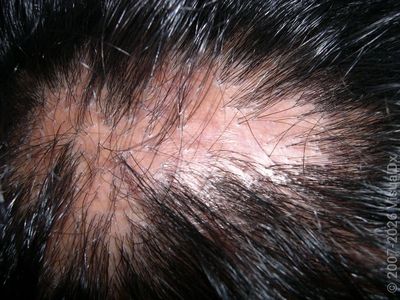
Scarring alopecia, also called cicatricial alopecia, refers to a group of hair loss disorders in which inflammation permanently damages the hair follicle and replaces it with scar tissue. Unlike more common forms of hair loss, scarring alopecia can lead to irreversible hair loss if not recognized and treated early.
These conditions are often misunderstood or mistaken for regular hair loss, dandruff, or breakage. However, symptoms such as scalp burning, itching, tenderness, bumps, pustules, or rapid thinning may signal active inflammatory disease that requires medical treatment.
Modern therapies can often slow or stop progression, reduce inflammation, improve symptoms, and help preserve remaining hair.
Common Types of Scarring Alopecia
What Causes Scarring Alopecia?
The exact cause depends on the specific subtype, but most forms involve an abnormal inflammatory response targeting the hair follicle stem cells located in the bulge region of the follicle. Once these stem cells are destroyed, the follicle loses its ability to regenerate hair.
Researchers believe scarring alopecia develops through a combination of:
- Immune system dysregulation
- Genetic susceptibility
- Environmental triggers
- Alterations in the scalp microbiome
- Mechanical or chemical injury in some cases
Different types involve different inflammatory pathways.
Lichen Planopilaris (LPP) is an inflammatory scarring alopecia in which the immune system targets hair follicles, leading to permanent follicle destruction if not controlled early. Fibrosing Alopecia in a Pattern Distribution (FAPD) is considered an overlapping condition that combines features of LPP with androgenetic hair loss, often requiring a combination treatment approach.
Treatment focuses on stopping active inflammation to prevent further irreversible hair loss. Topical corticosteroids are commonly used to reduce surface inflammation and symptoms such as itching or burning. Intralesional corticosteroid injections are often used along areas of active disease to directly suppress follicular inflammation.
Oral anti-inflammatory therapies are frequently required for more widespread or progressive disease. These include doxycycline for its anti-inflammatory effects and hydroxychloroquine for immune modulation. In more active cases, systemic immunomodulators such as methotrexate or mycophenolate mofetil may be used, and short courses of oral corticosteroids may be considered for rapid disease control.
Low-dose oral naltrexone (LDN) is increasingly used as an adjunctive off-label therapy in inflammatory scarring alopecias. It is thought to help regulate immune dysregulation and reduce inflammatory signaling. Patients may report improvement in scalp burning, tenderness, and overall inflammatory symptoms when LDN is added to a standard regimen.
Supportive care includes gentle hair practices, avoidance of traction or chemical irritation, and symptom-directed therapies for scalp discomfort.
Frontal Fibrosing Alopecia

Frontal Fibrosing Alopecia (FFA) is a progressive scarring alopecia characterized by recession of the frontal and temporal hairline and often eyebrow thinning. It is most commonly seen in postmenopausal women but can occur in other populations.
Early symptoms may include scalp itching, burning, or tenderness along the hairline. As the disease progresses, follicles are permanently destroyed and replaced with smooth, pale skin.
Treatment is focused on halting progression rather than regrowing scarred follicles. Topical corticosteroids and topical calcineurin inhibitors are used to reduce inflammation. Intralesional corticosteroid injections along the hairline and eyebrows are commonly used to control active disease.
Oral therapies such as doxycycline and hydroxychloroquine are frequently used to reduce inflammation and stabilize disease activity. In more aggressive cases, systemic immunomodulators such as methotrexate or mycophenolate mofetil may be considered. Short courses of oral corticosteroids may be used in rapidly progressive disease.
5-alpha reductase inhibitors such as finasteride or dutasteride may be considered in select patients, particularly when there is overlap with androgenetic alopecia.
Low-dose oral naltrexone may be used as an adjunct in some patients to help modulate immune activity and reduce inflammatory symptoms, particularly scalp discomfort.
Hair transplantation is only considered once the disease has been inactive for a prolonged period, as active inflammation can destroy transplanted grafts.
Central Centrifugal Cicatricial Alopecia (CCCA)
Central Centrifugal Cicatricial Alopecia (CCCA) is a progressive scarring alopecia that begins at the crown of the scalp and spreads outward symmetrically. It is most commonly seen in women of African descent but can affect all populations.
Patients may notice gradual thinning at the crown, increased shedding, breakage, or scalp tenderness. Over time, the scalp may become smooth and shiny due to permanent follicle loss.
Treatment focuses on stopping inflammation and preserving remaining follicles. Topical corticosteroids are used to reduce inflammation, often combined with topical calcineurin inhibitors for maintenance therapy. Intralesional corticosteroid injections are frequently used in active areas.
Oral anti-inflammatory agents such as doxycycline are commonly used for long-term control. Hydroxychloroquine or other systemic immunomodulators may be required in more severe cases.
Avoidance of traction hairstyles, heat, and chemical trauma is an essential part of management.
Low-dose oral naltrexone may be used as an adjunctive therapy in selected patients to help reduce inflammatory signaling and may be particularly helpful for scalp tenderness or burning.
Folliculitis Decalvans
Folliculitis Decalvans is a chronic inflammatory condition driven by abnormal immune response to bacteria on the scalp, most commonly Staphylococcus aureus, leading to recurrent infection and scarring hair loss.
Patients may develop painful pustules, crusting, redness, and sometimes drainage. A hallmark finding can be “tufted” hairs, where multiple hairs emerge from a single follicular opening.
Treatment requires both antimicrobial and anti-inflammatory strategies. Oral antibiotics such as tetracyclines are commonly used for their dual antimicrobial and anti-inflammatory effects. Combination antibiotic regimens may be used in more severe cases.
Topical antiseptic washes and medicated shampoos are often used for maintenance. Intralesional corticosteroid injections can help control active inflammation.
Isotretinoin may be considered in refractory cases. Biologic therapies may be used in severe, treatment-resistant disease.
Low-dose oral naltrexone may be considered in select patients as an adjunct for persistent inflammatory symptoms, though it is not a primary therapy.
Dissecting Cellulitis of the Scalp
Dissecting Cellulitis of the Scalp is a chronic inflammatory condition characterized by painful nodules, abscesses, and sinus tracts that can lead to scarring hair loss.
Treatment is typically multi-modal and long-term. Oral antibiotics are often used initially to reduce inflammation and secondary infection. Isotretinoin is one of the most effective medical therapies for long-term disease control.
Intralesional corticosteroid injections can reduce localized inflammation. In severe cases, biologic therapies targeting inflammatory pathways may be required. Surgical intervention may be necessary for persistent sinus tracts or advanced scarring disease.
Low-dose oral naltrexone may be used as an adjunctive therapy in select cases for immune modulation and symptom control.
Discoid Lupus Erythematosus
Discoid Lupus Erythematosus (DLE) is an autoimmune condition in which the immune system attacks the skin and scalp, leading to chronic inflammation and scarring hair loss.
Treatment focuses on immune control and prevention of progression. High-potency topical corticosteroids are commonly used for active lesions, along with intralesional corticosteroid injections for thicker plaques. Topical calcineurin inhibitors may be used for maintenance therapy.
Systemic treatment often includes hydroxychloroquine, which is a cornerstone therapy. More severe cases may require additional immunosuppressive agents.
Sun protection is essential, as ultraviolet exposure can worsen disease activity.
Low-dose oral naltrexone may be considered in select patients as an adjunctive therapy, although evidence is more limited compared to standard antimalarial therapy.
Acne Keloidalis Nuchae (AKN)
Dissecting Cellulitis of the Scalp is a chronic inflammatory condition characterized by painful nodules, abscesses, and sinus tracts that can lead to scarring hair loss.
Treatment is typically multi-modal and long-term. Oral antibiotics are often used initially to reduce inflammation and secondary infection. Isotretinoin is one of the most effective medical therapies for long-term disease control.
Intralesional corticosteroid injections can reduce localized inflammation. In severe cases, biologic therapies targeting inflammatory pathways may be required. Surgical intervention may be necessary for persistent sinus tracts or advanced scarring disease.
Low-dose oral naltrexone may be used as an adjunctive therapy in select cases for immune modulation and symptom control.